
untitled
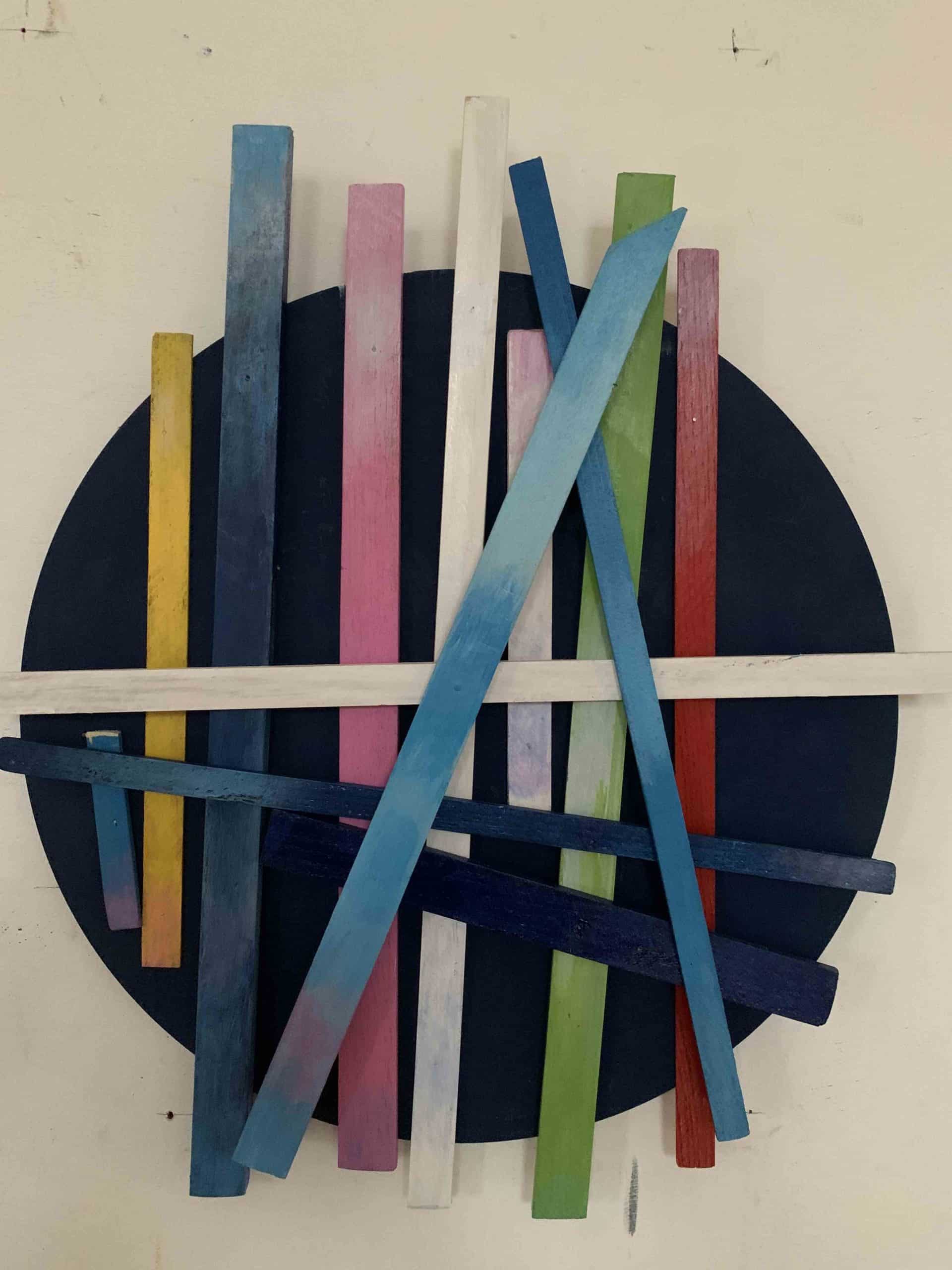
I imagine that, once the decision had been made to use a basic geometric shape as the underlying form and to ensure the appropriate proportions of the slats, Andreas Felger experimented with the placement of the slats as if they were the hands of a clock, moving the pieces of wood around and varying the composition until the ‘image’ felt right. It is worth pausing for a moment to consider what ‘feeling right’ means: An aesthetic tension is created whilst, at the same time, a sense of balance is established. The result is varied but not restless; the individual slats stand out on their own, as it were, like soloists, yet also function as a collective, in relation to one another; their formation stems essentially from finely adjusted angles of inclination, which can take on an almost humanising quality; leaning towards one another, corresponding with one another.
The strips, which are positioned perpendicular to the vertical lines, have a different character. Although similar in form and colour to those considered so far, they resemble the slats of a fence, and their materiality stands out. Formally, they appear to cross out the vertical lines or the minimally sloping diagonals, counteracting the delicacy of the composition on the level below. This effect is, however, tempered by the fourth layer (including the circular form), comprising two further bars in a predominantly blue-whitish iridescent colour scheme. These are more sharply inclined and are the only ones that cross; they can be interpreted either as closing in on one another or as embracing each other.
A few further points of context should be added here: a number of the wooden reliefs were created in 2020/21, that is, in the year in which Andreas Felger responded to the COVID-19 pandemic through his painting. Most of these works were not as sombre as one might perhaps have expected during this period, which was very stressful and restrictive for many. The artist has found a way of approaching the subject that turns it into something positive; Kurt Freitag commented on one example in the Work of the Quarter 04.2020. There are many examples in Andreas Felger’s body of work of his engagement with relief, particularly in Art in public space. Some of the works demonstrate particularly clearly the artist’s interplay between surface and space, and between image and sculpture. In the Landmarks in Mössingen’s urban space, the incorporation of light and shadow is also evident; with appropriate lighting, this effect can also be achieved in the small-scale reliefs displayed indoors.
Last but not least, the artistic language of the reliefs is quite comparable to Andreas Felger’s works painted in oil or acrylic, which often feature beam-like forms. Hans Günter Zehnder commented on an example in Work of the Quarter 04.2024. His description – “At first glance, one perceives the dense structures as a kind of latticework; one associates them with entanglement; one thinks of a thicket and of penetrating it” – can also be applied to the interplay and overlapping of the slats. It is fascinating to see how, despite the bulky nature of the wooden slats, an aesthetic space with illusionist effects emerges – one that always serves as a space for the viewer’s own projections.
Text by Marvin Altner
Marvin Altner holds a doctorate in art history and is a lecturer in art studies at the University of Kassel. After a traineeship at the Hamburger Kunsthalle, he worked as a research assistant and curator at museums in Berlin and Hamburg and as a freelance author in the field of visual arts from the 19th century to the present. Since 2012, he has been teaching at the Kunsthochschule Kassel in the art studies program and works as a research assistant for the Andreas Felger Kulturstiftung, including as author, exhibition coordinator, and supervisor of the database of Andreas Felger’s works.