
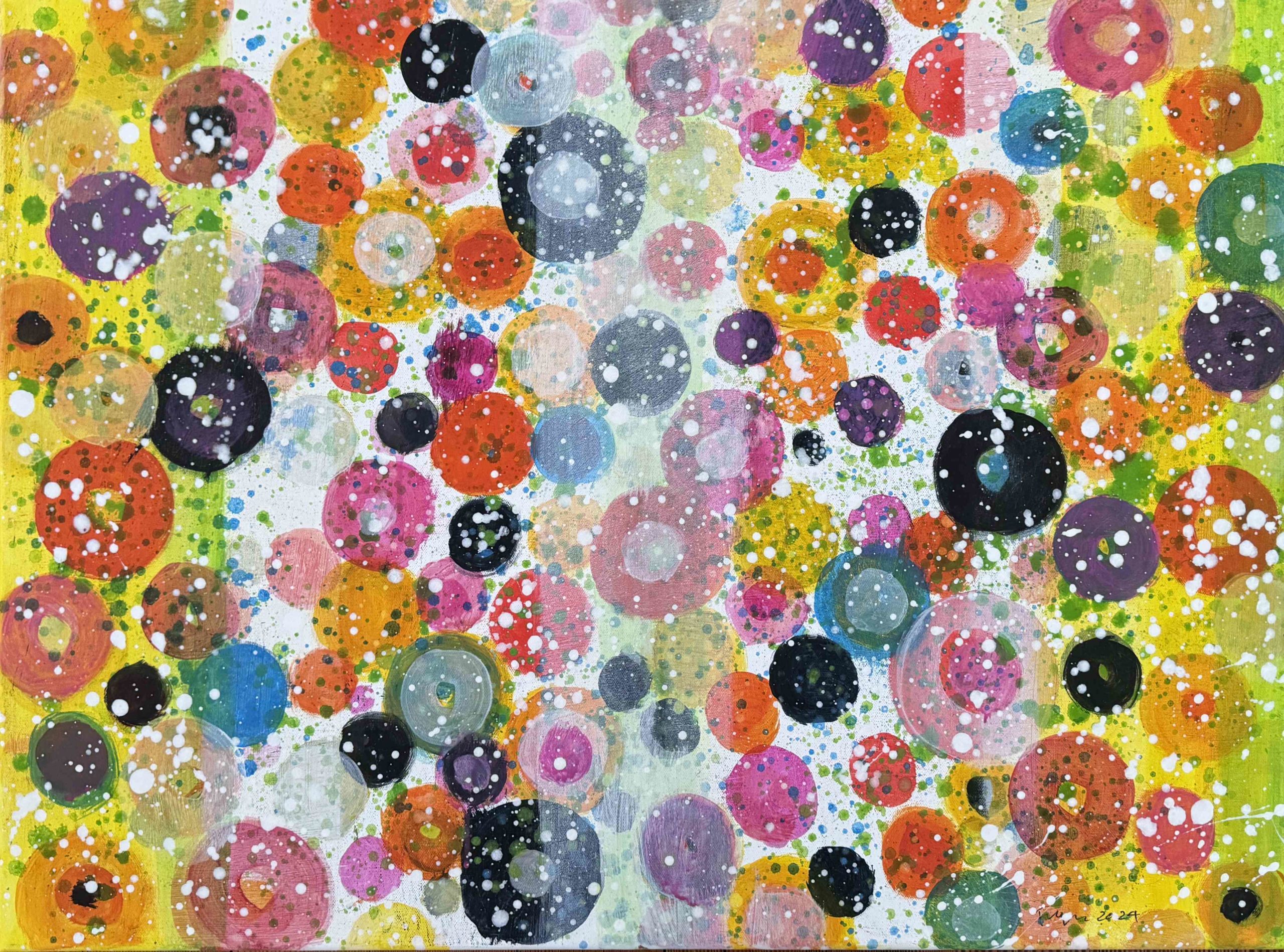
untitled
‘When painting, thinking is painting’ (“Das Denken ist beim Malen das Malen”) – with this much-quoted statement, as memorable as it is open to interpretation, Gerhard Richter characterised the particular complexity of the cognitive, emotional and visual potentials that interact when form is placed upon form and colour upon colour on paper or canvas. Painting is an additive process, an art of addition, the result of which – depending on the technique used – is made more or less visible, or even concealed.
One explicit variation on this approach involves the use of patterns, grids and serial forms, arranged into repetitive structures. We might imagine that Andreas Felger was guided by this process-oriented intuition whilst painting the Work of the Quarter selected here, mediating, step by step, between the preceding and subsequent brushstrokes, thereby continuously transforming the picture surface; it is only as the process unfolds that it becomes apparent even to the artist what result, what work, the treatment of the canvas is leading towards.
The precision with which the individual round discs of colour have been placed, the spatial nuances created by delicate bands of white and yellowish-green, which act as filters for certain parts of the picture, and the interplay of action and chance evident in the drops of paint added last, all combine to create a whole that is planned and controlled, yet at the same time appears fluid and playful.
Just as Richter, born in 1932, brought his early career as a stage and mural painter to an end and established himself as a freelance artist (following a brief period of study in informal painting in Düsseldorf), so too did Andreas Felger, born in 1935, bring his career as a pattern draughtsman and textile designer to an end after studying fine art in Munich and devote himself to the fine arts. Both are united by their emphasis on the practice of painting, which generates a momentum of its own. And for both artists, their early experiences – and the influences they brought with them – are woven into their later working methods.
Text by Marvin Altner
Marvin Altner holds a doctorate in art history and is a lecturer in art studies at the University of Kassel. After a traineeship at the Hamburger Kunsthalle, he worked as a research assistant and curator at museums in Berlin and Hamburg and as a freelance author in the field of visual arts from the 19th century to the present. Since 2012, he has been teaching at the Kunsthochschule Kassel in the art studies program and works as a research assistant for the Andreas Felger Kulturstiftung, including as author, exhibition coordinator, and supervisor of the database of Andreas Felger’s works.