
Bruges
Every picture tells a story. It’s worth exploring it.
Or: How Andreas Felger became our tour guide.
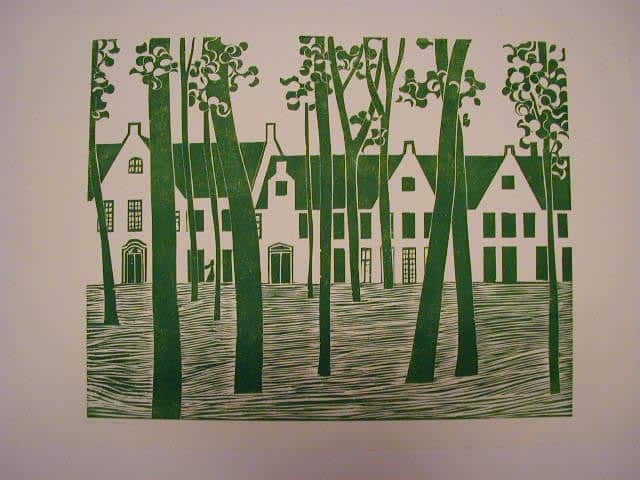
A woodcut rendered in a pleasant, rich green: the abstract geometry of the buildings in the background is overlaid by ornamental trees in the foreground that seem to reach up towards the sky. The meadow in which the trees are actually rooted appears to be in a state of undulation – quite as if the trunks were standing in water. It is only at second glance that two details on the left-hand edge of the picture attract attention: an eye appears in the pediment above the door – a frequent symbol of the divine in the art of Andreas Felger (see Work of the Quarter 04_2025). A little further to the right, between the floor-to-ceiling windows, the silhouette of a female figure with a flowing robe flits from left to right.
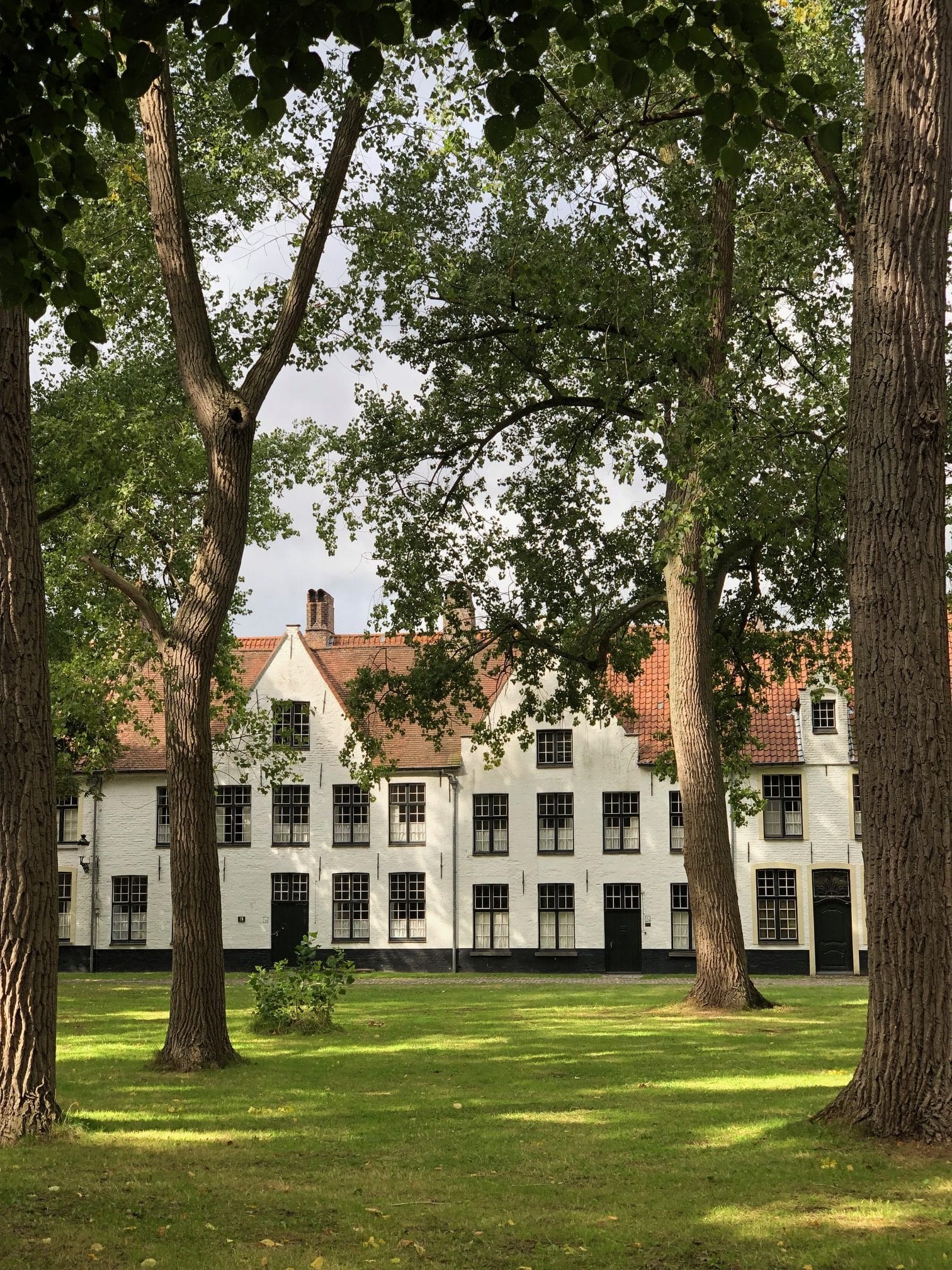
This heirloom has been hanging above our sofa for some time now and makes the room feel a little more spacious. We enjoy the view it offers and keep discovering something new about it. This was also the case when a friend came to visit. ‘That’s Bruges! I was there recently.’ We’d read the caption – a rare source of context beneath Felger’s works – but it only really came to life when our friend showed us the photos on his mobile: the same tall trees, the same lush greenery, a picturesque house façade and, in the background here too, a nun passing through the frame. It turns out that the place in Bruges is called the Beguinage; it is a UNESCO World Heritage Site and was founded in the 13th century. Beguines once lived here in seclusion – self-determined women who led a devout and celibate life. We decide that one day we want to see this place with our own eyes.
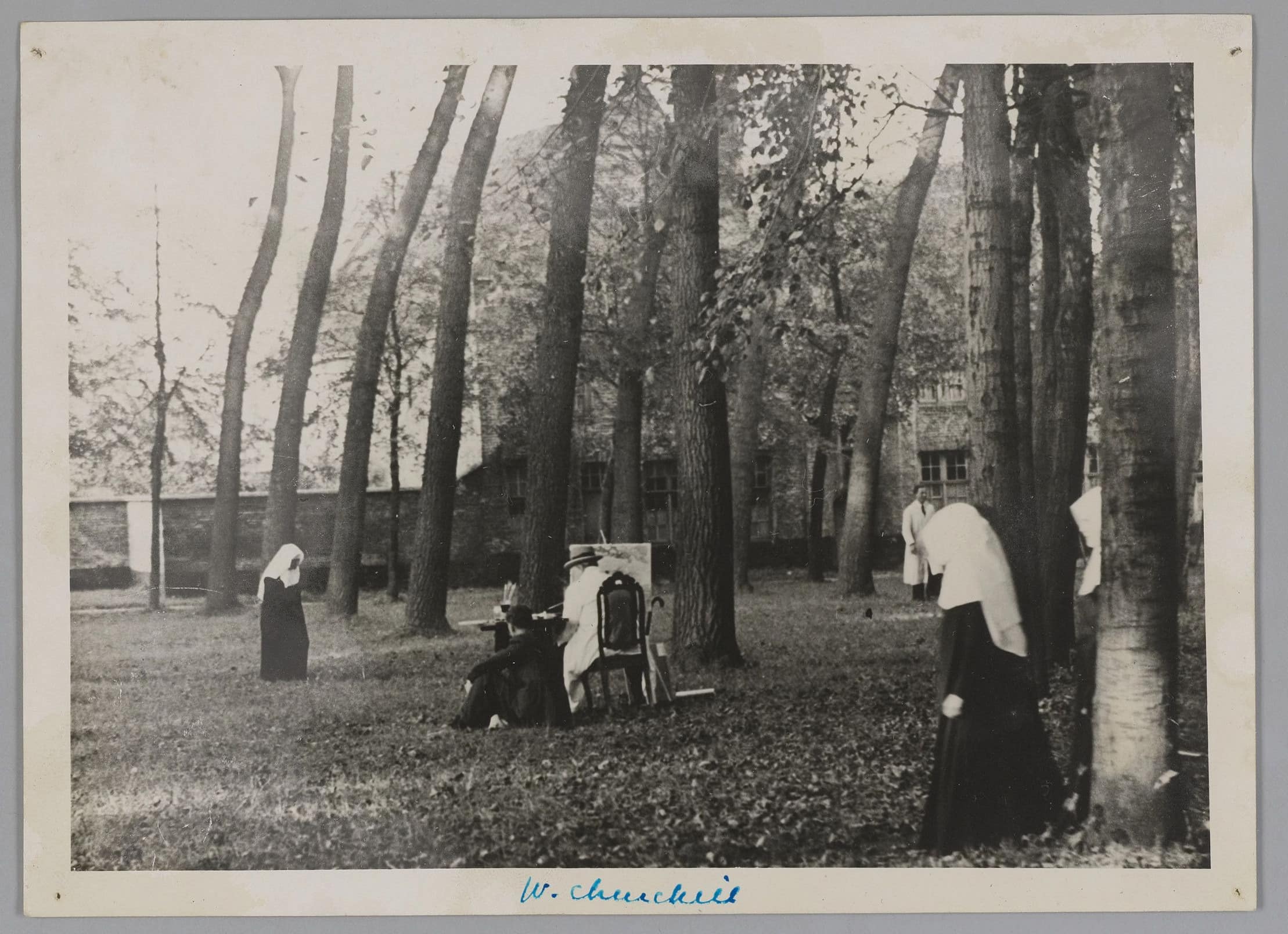
Some time later, whilst on a cycling trip from France to the Netherlands, we actually pass through the impressive city of Bruges. We stop at the Beguinage, and the view we’d formed from our living room, shaped by Andreas Felger, blends with new perspectives. Familiar, yet new. Some things have changed over the years, but the depth and tranquillity of the place remain. Beautiful and inspiring – not just for Andreas Felger and for us: even Winston Churchill once sat in the Beguinage and captured the scene on his easel.
And so the story behind the picture continues. ‘To form a picture’ – that has a double meaning. Both through the eyes of others and through one’s own. Thank you, Andreas Felger, for broadening my horizons. Pictures can be the start of a journey – I’m sure you, too, have a story to tell about this.
Text by Benedikt Schweizer
Benedikt Schweizer, a political scientist and theologian, worked as a freelancer for the Andreas Felger Cultural Foundation whilst he was a student. He archived many of Andreas Felger’s works and, amongst other things, travelled around Germany with the Credo exhibition. He now works as an adviser at the Baden-Württemberg Ministry of Economic Affairs, Crafts and Tourism.