
untitled
Many images reveal their subtleties, their complexity, and their inner dynamics only upon longer observation. Longer also means approaching the work with a different attitude than that of everyday image consumption. This does not have to be a reverent attitude, nor does the image have to be a devotional image such as the depiction of Mary as an icon on a medieval house altar (although it can be, even in front of abstract art, as Martina and Martin Schockenhoff’s commentary on the Work of the Quarter 04.2022 suggests). However, the viewer’s attention should allow space for different ways of seeing, with an investigative gaze at the details, with a gaze into the depths, as if the picture surface were a landscape that expands the eye, and with a gaze that allows for a process in which we gradually perceive how the components of the image interact with each other (Frank Günter Zehnder described such a process, which can take on labyrinthine dimensions, in Work of the Quarter 04.2024).
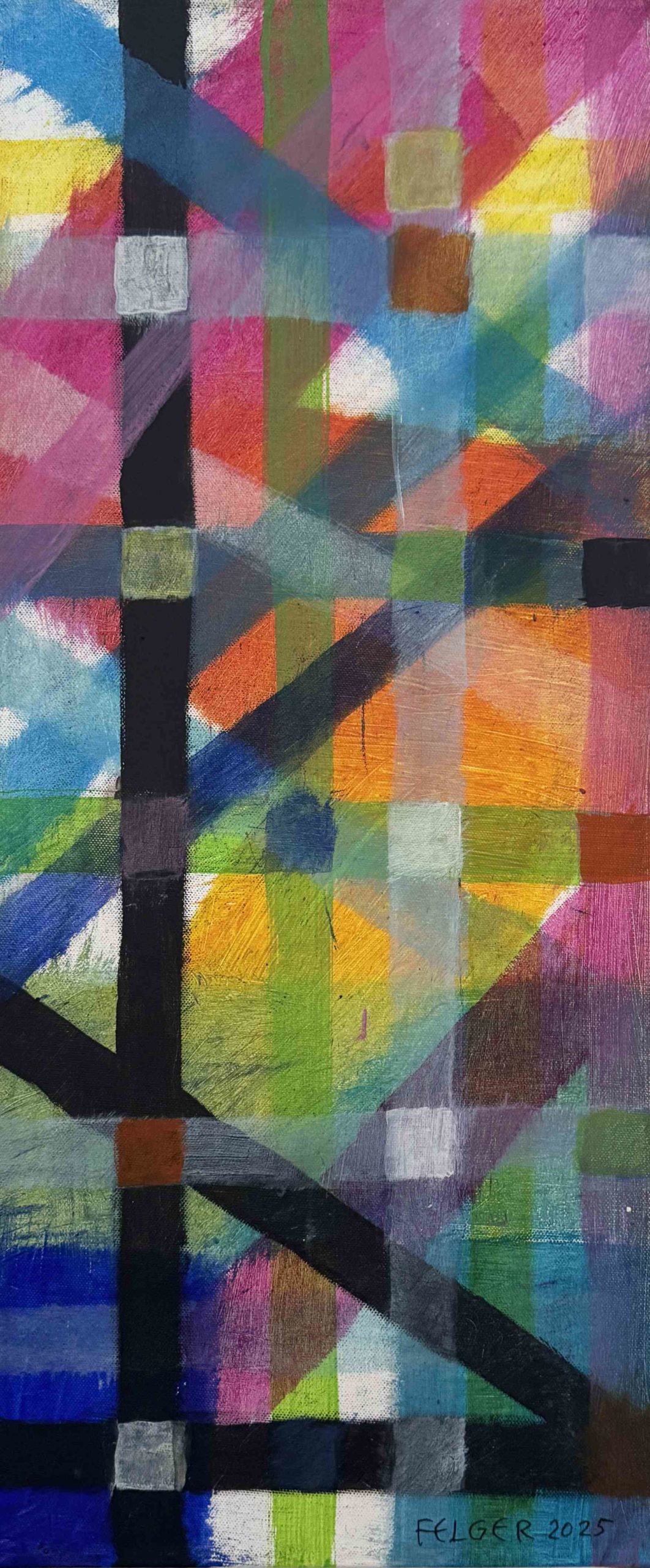
What does this mean for the reception of the work shown here? We follow the colour paths, observe the colour mixtures at their intersections, “feel” the irregular edges of the lines, delve into the interplay of colours that are sometimes brightly protruding and sometimes dull on the canvas. Pale whitish stripes only become noticeable after a while next to the dominant dark bars, as does the horizontal tripartite division, which is revealed by the bold use of colour in the lower third, brighter colours in the middle and more delicate tones in the upper third of the picture surface. In the quick-drying acrylic paint, the imprint of the brush bristles remains visible in the paint material, which is why the luminosity of the pigments always remains connected to the texture created by the brushwork. When we see the interplay of all the nuances of these colours – perhaps without even realising how long we have been looking at them – we may actually become a little reverent, also in view of a picture format that leads our gaze from bottom to top, into areas, which are brighter, lighter, more open.
Text by Marvin Altner
Marvin Altner holds a doctorate in art history and is a lecturer in art studies at the University of Kassel. After a traineeship at the Hamburger Kunsthalle, he worked as a research assistant and curator at museums in Berlin and Hamburg and as a freelance author in the field of visual arts from the 19th century to the present. Since 2012, he has been teaching at the Kunsthochschule Kassel in the art studies program and works as a research assistant for the Andreas Felger Kulturstiftung, including as author, exhibition coordinator, and supervisor of the database of Andreas Felger’s works.